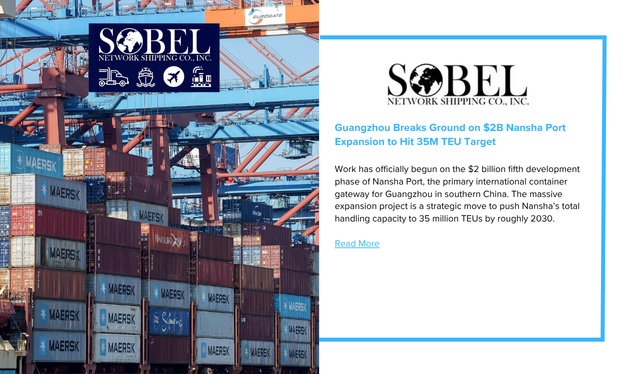
Work has officially begun on the $2 billion fifth development phase of Nansha Port, the primary international container gateway for Guangzhou in southern China. The massive expansion project is a strategic move to push Nansha’s total handling capacity to 35 million TEUs by roughly 2030.
According to China’s Transport Ministry, main construction launched on Friday. The blueprint includes four mega-berths designed to handle ultra-large container vessels exceeding 21,000 TEUs, alongside 15 dedicated berths for regional feeder ships. Spanning a combined berth length of 2.4 miles, this extension alone will inject an additional 6.7 million TEUs of capacity into Nansha’s operations.
Complementing this project, the Guangzhou Port Group is also constructing the $1 billion Nansha International General Terminal. This facility will add 500,000 TEUs of capacity and feature specialized berths for breakbulk, project cargo, and automotive shipments.
Guangzhou Port Group Chairman Huang Bo noted that the combination of the phase five expansion, the general terminal, and concurrent pipeline projects will ultimately add 11 million TEUs of active operating capacity to the port, which sits roughly 40 miles south of Guangzhou city.
Shift in the Pearl River Delta
The aggressive expansion comes amid shifting volume dynamics in the Pearl River Delta. Guangzhou’s container growth continues to keep stride with its neighboring rival, Shenzhen (located 60 miles south), as both mainland hubs systematically siphon volumes away from Hong Kong.
Data highlights the shifting competitive landscape:
-
Guangzhou/Nansha: Guangzhou saw overall throughput climb 8% last year to eclipse 27 million TEUs—with Nansha handling the lion’s share at over 22 million TEUs. The momentum carried into early this year, with total throughput rising 4% to 9 million TEUs through April.
-
Shenzhen: Volumes grew 5% last year to hit 35 million TEUs, with a sharp 8% acceleration in the first four months of this year, reaching 8.5 million TEUs.
-
Hong Kong: In contrast, Hong Kong’s volumes continue a downward trajectory. Throughput fell 5% last year to 13.7 million TEUs and slid an additional 7% through April of this year to 4.2 million TEUs.
As global supply chains continue to optimize for vessel size and regional feeder efficiency, Guangzhou’s $3 billion total investment firmly positions Nansha to capture a dominant share of future transpacific and intra-Asia trade lanes.