
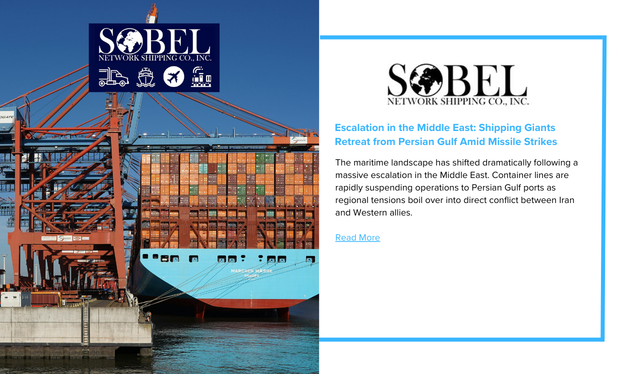
The maritime landscape has shifted dramatically following a massive escalation in the Middle East. Container lines are rapidly suspending operations to Persian Gulf ports as regional tensions boil over into direct conflict between Iran and Western allies.
The instability follows the “Epic Fury” operation, a joint Israel-U.S. strike that resulted in the death of Iran’s Supreme Leader, Ayatollah Ali Khamenei. In a swift retaliatory wave, Tehran launched missile and drone strikes targeting key logistics hubs, including the Port of Jebel Ali in Dubai and various tanker vessels navigating the Strait of Hormuz.
Immediate Impact on Global Shipping
While the Strait of Hormuz—the artery for 20% of the world’s crude oil—remains officially open, the “de facto” closure is already underway as major carriers prioritize crew safety over schedules.
-
Vessel Diversions: Maersk, CMA CGM, and MSC have officially suspended or rerouted services.
-
Infrastructure Damage: A drone interception over Jebel Ali sparked fires at the terminal, raising alarms over the safety of UAE port infrastructure.
-
Military Claims: While Tehran claims to have struck the USS Abraham Lincoln with a ballistic missile, U.S. Central Command has issued a formal denial.
The Cost of Conflict: Surcharges and Rerouting
The financial fallout for cargo owners is immediate. CMA CGM has already implemented an Emergency Conflict Surcharge, significantly driving up the cost of trade in the region:
These fees apply to all major Persian Gulf destinations and Red Sea ports, including those in Saudi Arabia, Egypt, and Jordan. Furthermore, Maersk has diverted its MECL and ME11 services away from the Suez Canal, opting for the long transit around the Cape of Good Hope.
Expert Analysis: Regional Chaos vs. Global Scale
Despite the volatility, market analysts suggest the global economic impact may be more contained than the initial panic suggests. Peter Sand, Chief Analyst at Xeneta, notes that while the local disruption is “severe,” it differs from the Red Sea crisis.
“There is no viable alternative to getting containers in or out of ports such as Jebel Ali by ocean if the Persian Gulf is off-limits. Carriers will omit these calls and drop boxes at a ‘least-worst’ alternative port for onward road transport.”
Because 80% of Iran’s oil is exported to China, the immediate impact on Western energy prices has been tempered, though container rates from Asia had already begun climbing in mid-February as U.S. forces massed in the region.
The Return of the Houthi Threat
Adding to the complexity, Iran-sponsored Houthi rebels in Yemen have vowed to resume their campaign against Red Sea shipping. This multi-front maritime threat effectively forces the world’s largest carriers to abandon the Suez Canal once again, reverting to the extended Africa route used throughout much of 2024 and 2025.
