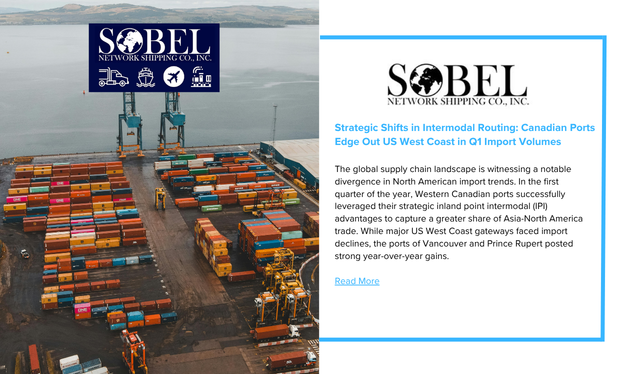
The global supply chain landscape is witnessing a notable divergence in North American import trends. In the first quarter of the year, Western Canadian ports successfully leveraged their strategic inland point intermodal (IPI) advantages to capture a greater share of Asia-North America trade. While major US West Coast gateways faced import declines, the ports of Vancouver and Prince Rupert posted strong year-over-year gains.
According to data from Sea-Intelligence Maritime Analysis, containerized imports through Vancouver—Canada’s largest gateway—rose 9% year over year in Q1. Prince Rupert followed closely with a 7.8% volume increase. Conversely, US West Coast counterparts experienced broad contractions: imports dipped 3.6% in Los Angeles, 5.6% in Long Beach, 6.8% in Oakland, and a steep 18% at the Northwest Seaport Alliance (NWSA) of Seattle and Tacoma.
For logistics managers evaluating cost and transit efficiency, this volume shift highlights several distinct structural advantages offered by the Canadian rail network.
The Fuel and Topography Factor in Intermodal Costs
A primary driver behind the Canadian surge is the significantly lower cost of rail transport from Western Canada to the US Midwest compared to traditional US routes. The geographical routing through the Canadian Rockies features a much lower altitude threshold than the US Rocky Mountains.
This topographical advantage translates directly to fuel efficiency. Moving a intermodal train from Vancouver to Chicago requires substantially less fuel than routing a train out of Los Angeles-Long Beach, Northern California, or the Puget Sound. For shippers, these fuel savings heavily influence total landed costs.
Tariff Navigation and Cargo Repatriation
While broad tariffs on Asian imports affect retailers regardless of whether goods enter through US or Canadian marine terminals, the lingering duty structures have forced changes in how multi-national “big-box” retailers handle regional distribution.
Historically, many retailers with footprints in both countries shipped Canadian-bound merchandise nested within larger US shipments. These containers would clear a US West Coast port before the Canadian freight was segregated and trucked north. To avoid unnecessary exposure to US customs duties on transit cargo, major retailers are increasingly routing Canadian-destined freight directly through Vancouver or Prince Rupert. This repatriation of cargo has provided a consistent baseline of growth for British Columbia ports.
Mitigating Red Sea Disruptions and Domestic Taxes
The growth in Western Canada is also driven by shifting domestic dynamics and broader maritime disruptions. Ongoing vessel security risks in the Red Sea have effectively closed the Suez Canal routing for many carriers, forcing costlier, longer transits around Africa. As a result, routing goods from Asia through Vancouver and railing them to Central Canada has become more cost-effective than utilizing traditional East Coast entries like Montreal or Halifax.
Furthermore, high-volume importers of high-value merchandise continue to utilize Canadian gateways to legally bypass the US Harbor Maintenance Tax (HMT), optimizing their supply chain spend.
Looking Ahead: Capacity Expansion and Market Dynamics
While Vancouver notes that its growth is increasingly driven by domestic Canadian demand—with US-destined cargo dropping from 25% of its volume in 2010 to roughly 8% today—both Canadian ports are actively expanding infrastructure to handle fluid international volumes. Prince Rupert is currently developing its LinX intermodal center, set to open in 2027, to further boost terminal-to-rail efficiencies.
Despite the Q1 contractions in the US, market share across North American coasts remains highly dynamic. While East and Gulf Coast ports have captured steady baseline volumes over the last decade due to proximity to major population centers, the West Coast can experience sharp monthly swings. US West Coast market share for Asian imports rallied significantly toward the start of Q2, climbing to 61.9% from a March low of 53.2%.
For international shippers, these fluctuations underscore the necessity of a flexible routing strategy. Utilizing agile intermodal corridors—including the cost-efficient Canadian gateways—remains a critical tool for mitigating risk, avoiding port congestion, and managing total freight spend.