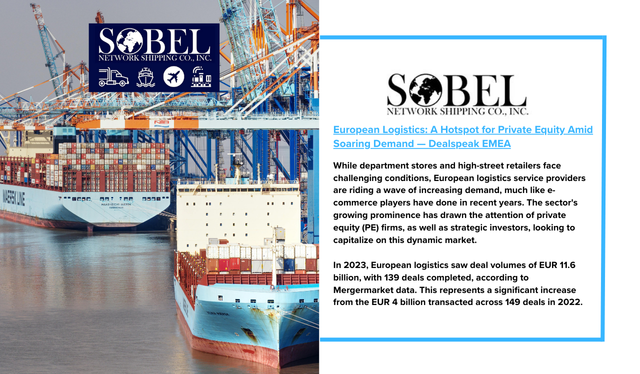
While department stores and high-street retailers face challenging conditions, European logistics service providers are riding a wave of increasing demand, much like e-commerce players have done in recent years. The sector’s growing prominence has drawn the attention of private equity (PE) firms, as well as strategic investors, looking to capitalize on this dynamic market.
In 2023, European logistics saw deal volumes of EUR 11.6 billion, with 139 deals completed, according to Mergermarket data. This represents a significant increase from the EUR 4 billion transacted across 149 deals in 2022. So far in 2024, 77 deals have been closed, representing EUR 2.7 billion in volume, though this is a notable decline compared to the EUR 9.2 billion in deals achieved by the same time last year.
Despite the slowdown, the sector continues to see major activity. A standout example is Blackstone’s decision to acquire an 80% stake in Burstone’s pan-European logistics portfolio for EUR 1.1 billion. This marks a significant investment in the industry, highlighting PE firms’ confidence in the sector’s long-term growth potential.
Value Creation in a Fragmented Market
Nicolas Witt, Director and Head of Logistics at MCF, explains that PE firms are well-positioned to deliver value by developing integrated supply chains, creating niche market leaders, or focusing on last-mile solutions. These strategies are particularly effective in fragmented markets, where many sizeable, family-owned businesses face succession challenges. Buy-and-build approaches have emerged as a key tool for sponsors looking to consolidate these fragmented markets and unlock value.
Corporate Deals Signal Record-Breaking Potential
Corporate acquisitions are also making waves in the European logistics space, with 2024 set up as a potentially record-breaking year. Danish transportation group DSV recently announced its intention to acquire DB Schenker, a Germany-based logistics company owned by Deutsche Bahn, in a deal valued at EUR 14.3 billion. This massive transaction is poised to dramatically elevate total deal volumes for the year.
Geopolitical Forces Reshape the Logistics Landscape
The global pandemic and geopolitical tensions have brought newfound attention to the importance of the logistics sector. Supply chain disruptions during COVID-19 revealed vulnerabilities, and Russia’s invasion of Ukraine in 2022 further emphasized the need for alternative trade routes. One such alternative, the Middle Corridor—which connects Europe to China via Kazakhstan, Georgia, and sometimes Turkey—has gained importance following sanctions on Russia.
European logistics providers are responding by expanding their reach and offering comprehensive solutions that span from the Atlantic coast to the Bosporus and beyond. A notable example is DFDS, a Danish shipping company, which acquired Turkish logistics provider Ekol Logistics in April for EUR 260 million, a move designed to capitalize on the growing significance of the Middle Corridor.
Deal Pipeline Looks Promising
Looking ahead, the European logistics sector shows no signs of slowing down. Among the companies expected to come to market soon is Suret, a Poland-based industrial logistics provider owned by Tar Heel Capital. Its Likely to Exit (LTE) score of 48 suggests a possible transaction on the horizon. Similarly, Cacesa, Iberia’s former air cargo logistics operator, has an LTE score of 46, though its sale process has been quiet since Spanish PE firm Talde Private Equity hired Lazard to prepare for it earlier this year.
Another potential target is Groupe STG, a French transportation services provider acquired by Hivest Capital Partners in 2018, with an LTE score of 45.
The Future of European Logistics
With clear skies ahead, European logistics remains a prime sector for dealmakers. As PE firms and corporate players alike seek to tap into the sector’s immense potential, expect to see continued activity and consolidation across the region. With geopolitical and economic forces reshaping supply chains, the logistics sector stands ready to ride a new wave of growth and investment.