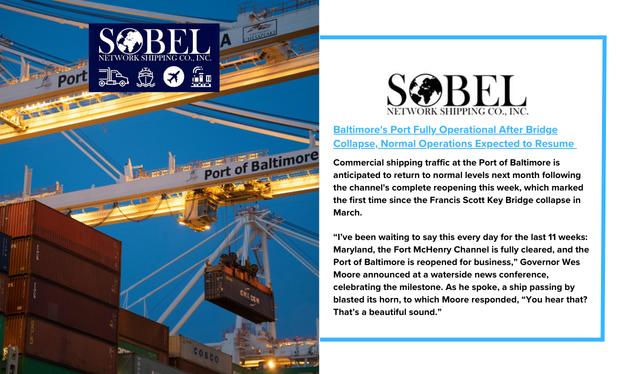
Commercial shipping traffic at the Port of Baltimore is anticipated to return to normal levels next month following the channel’s complete reopening this week, which marked the first time since the Francis Scott Key Bridge collapse in March.
“I’ve been waiting to say this every day for the last 11 weeks: Maryland, the Fort McHenry Channel is fully cleared, and the Port of Baltimore is reopened for business,” Governor Wes Moore announced at a waterside news conference, celebrating the milestone. As he spoke, a ship passing by blasted its horn, to which Moore responded, “You hear that? That’s a beautiful sound.”
Behind him, massive cranes moved shipping containers from a docked cargo ship to land.
Following the deadly collapse in March, many shipping companies diverted their cargo to other ports, as the disaster halted most maritime traffic through Baltimore’s bustling port. Crews worked tirelessly to clear an estimated 50,000 tons of steel and concrete from the Patapsco River, with the salvage operation costing approximately $160 million, involving federal, state, and local agencies.
With the channel restored to its original depth and width, officials believe companies that previously avoided Baltimore will return. The port, which handles more cars and farm equipment than any other in the country, is expected to resume normal operations by mid-July. U.S. Transportation Secretary Pete Buttigieg emphasized that rerouted commercial traffic “belongs in Baltimore today,” and expressed confidence that this will occur, reinforcing this expectation with supply chain stakeholders.
Portions of the deep-draft channel were reopened in phases, allowing some commercial traffic in recent weeks. Some cruise ships and large container ships have already passed through, according to officials.
The collapse had significant economic ripple effects, impacting thousands of longshoremen, truckers, and small business owners beyond the Baltimore region. State officials implemented several relief programs to support employment and businesses. “We were a wounded port,” said Scott Cowan, president of the International Longshoreman’s Association Local 333, representing Baltimore port workers. In the competitive industry, other ports were vying for Baltimore’s cargo.
Reopening the channel secures thousands of jobs for longshoremen, Cowan noted. The salvage operations for the U.S. Army Corps of Engineers are estimated to cost up to $75 million, while the Coast Guard response has cost $24 million to date. Maryland utilized around $60 million in federal emergency funds to open three smaller channels outside the main one. Rebuilding the bridge could cost nearly $2 billion and is hoped to be completed by 2028.
President Joe Biden has pledged federal support to cover the full cost of the bridge’s reconstruction, though funding is still pending congressional approval. In a statement on Tuesday, Biden commended those involved in the recovery effort, stating, “Baltimore can count on us to stick with them every step of the way, and we will continue to have your back until the bridge is rebuilt.”
The cargo ship Dali lost power and crashed into a critical support column of the Francis Scott Key Bridge on March 26, causing the collapse and resulting in the deaths of six roadwork crew members. A National Transportation Safety Board investigation revealed that the vessel experienced power outages before its voyage, though the exact causes of the electrical issues are still under investigation. The FBI is also conducting a criminal investigation. The Dali, stuck amid the wreckage for nearly two months with a massive steel truss across its damaged bow, was refloated and returned to port on May 20. This allowed officials to open a channel 50 feet deep and 400 feet wide, sufficient for most large commercial vessels. The full federal shipping channel, now fully operational, is 700 feet wide, allowing for two-way traffic and lifting additional safety restrictions due to the increased width.