
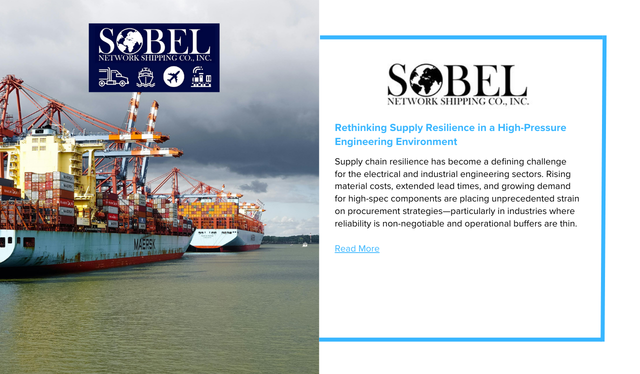
Supply chain resilience has become a defining challenge for the electrical and industrial engineering sectors. Rising material costs, extended lead times, and growing demand for high-spec components are placing unprecedented strain on procurement strategies—particularly in industries where reliability is non-negotiable and operational buffers are thin.
Across global markets, the availability of critical electrical components has tightened significantly. Prices and lead times for essential grid and power-related materials have surged since the early 2020s, creating bottlenecks that now ripple through aerospace, defense, energy, and advanced manufacturing supply chains. Volatility in key commodities has further intensified the pressure, with sharp price movements quickly translating into higher contract costs and sourcing challenges.
At the same time, structural constraints in raw material production are compounding the issue. Limited mining capacity, combined with accelerating electrification across transportation, infrastructure, and industry, has placed sustained pressure on metals such as copper and silver. When constrained supply meets rising demand, manufacturers are left navigating longer lead times, unpredictable availability, and increased exposure to disruption.
When Engineering Timelines Outpace Procurement
One of the most persistent challenges in this environment is misalignment between engineering execution and procurement planning. Projects often accelerate faster than expected, while sourcing strategies lag behind real-time demand shifts. When materials are unavailable or delayed, engineering teams are forced into reactive decision-making—introducing risk, cost overruns, and potential production delays.
In sectors where systems are mission-critical, the margin for error is minimal. Maintaining continuity increasingly depends not only on technical design excellence, but on procurement models that provide real-time visibility, flexibility, and alignment across teams.
Inventory Visibility as a Strategic Advantage
To address these pressures, many organizations are rethinking how inventory is managed and forecasted. Approaches that emphasize shared visibility and continuous monitoring are gaining traction as a way to stabilize supply chains under volatile conditions.
By tracking material usage directly at operational sites and updating forecasts dynamically, inventory-led procurement models allow engineering, supply chain, and procurement teams to work from a single source of truth. This alignment helps ensure that stock levels, inbound shipments, and component status are clearly understood—reducing surprises and enabling more informed design and sourcing decisions.
Beyond availability, greater visibility also supports technical oversight, including shelf-life management, qualification requirements, and compliance with industry standards. Just as importantly, it reduces administrative friction and minimizes downtime caused by missing or delayed components.
Flexibility During Disruption
The real value of visibility-driven procurement becomes most evident during periods of disruption. When long lead times threaten production schedules, access to approved alternatives already in stock can mean the difference between a stalled project and uninterrupted delivery. The ability to pivot quickly—without compromising technical or regulatory requirements—provides both cost savings and operational resilience.
However, systems alone are not enough. Effective supply resilience depends on deep supplier relationships, technical expertise, and early insight into market shifts. Long-standing partnerships enable earlier warnings of shortages, better alignment on specifications, and smoother navigation of evolving compliance requirements in highly regulated industries.
Procurement as an Engineering Imperative
Today, supply chain risk is no longer a secondary operational concern—it is a core engineering challenge. As demand for advanced electrical components continues to rise, procurement models that prioritize transparency, continuity, and adaptability are becoming essential to sustaining complex systems.
By aligning inventory with real-time consumption and integrating procurement more closely with engineering workflows, organizations can reduce disruption, control costs, and protect system integrity. In an era of constrained supply and accelerating demand, smarter approaches to supply resilience are no longer optional—they are foundational to long-term performance.
