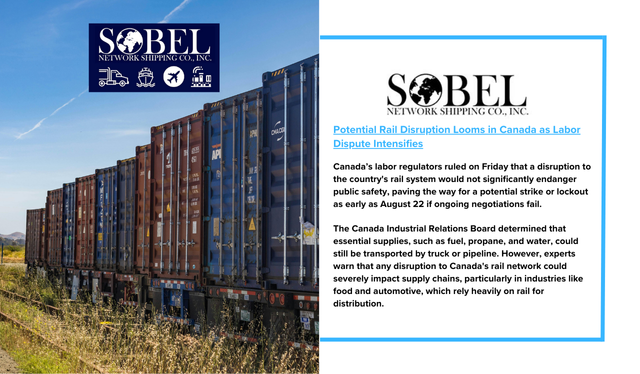
Canada’s labor regulators ruled on Friday that a disruption to the country’s rail system would not significantly endanger public safety, paving the way for a potential strike or lockout as early as August 22 if ongoing negotiations fail.
The Canada Industrial Relations Board determined that essential supplies, such as fuel, propane, and water, could still be transported by truck or pipeline. However, experts warn that any disruption to Canada’s rail network could severely impact supply chains, particularly in industries like food and automotive, which rely heavily on rail for distribution.
The board implemented a 13-day cooling-off period, granting a two-week window before any labor action could occur. This period allows the Teamsters Canada Rail Conference to continue negotiations with Canadian National Railway (CN) and Canadian Pacific Kansas City (CPKC). Talks resumed on August 7.
Despite ongoing discussions, no new contract has been finalized to replace the one that expired at the end of last year. The slow pace of progress has left some stakeholders skeptical about avoiding a disruption.
“There’s a high likelihood we’ll see a work stoppage at both railroads,” CPKC President and CEO Keith Creel told analysts during the company’s earnings call last month, predicting that a stoppage could occur by the end of August.
As concerns grow, Canada’s major railroads have already reported a decline in international freight business.
John Brooks, EVP and chief marketing officer at CPKC, attributed a 9% year-over-year drop in Q2 international volume to the looming possibility of a strike. Canadian National CEO Tracy Robinson echoed these concerns during the company’s July 23 earnings call, noting that while operations were normal, international freight diversions were already happening. Robinson added that even if an agreement is reached, it will take time to restore international business to Canadian ports.
The Teamsters union has stated that it will provide the required 72-hour notice before initiating any strike action. Key issues in the labor negotiations include wages, crew scheduling, and fatigue management, according to the union.
In a bid to resolve the contract impasse quickly, Canadian National requested on Friday that Canada’s minister of labor order binding arbitration, a move the union has previously rejected.
Meanwhile, CPKC has aligned with Canadian National, indicating that it would begin a phased shutdown of its network if a new labor deal is not reached. In a statement on Friday, CPKC announced it would lock out the Train and Engine division and the TCRC – Rail Traffic Controller division on August 22 unless a new agreement is negotiated or the parties agree to binding arbitration.