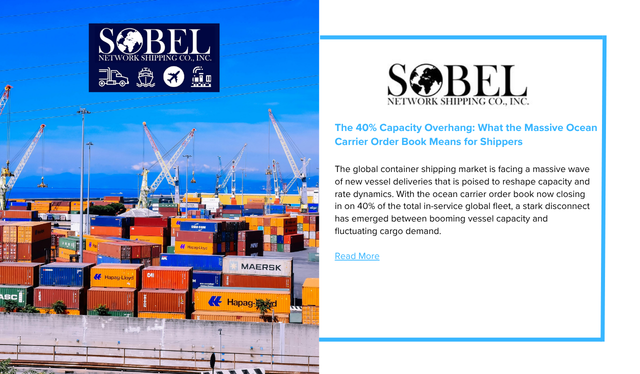
The global container shipping market is facing a massive wave of new vessel deliveries that is poised to reshape capacity and rate dynamics. With the ocean carrier order book now closing in on 40% of the total in-service global fleet, a stark disconnect has emerged between booming vessel capacity and fluctuating cargo demand.
For logistics professionals and shippers, understanding how carriers plan to manage this massive supply overhang is critical for navigating the peak seasons ahead.
The Earnings Squeeze and the Capacity Cushion
Despite solid volume growth in the first quarter of the year—including a 14% volume jump for HMM and a 9% increase for Maersk—average freight rates dragged down overall carrier earnings. Major lines like Hapag-Lloyd even posted first-quarter losses as weaker rates eroded revenue across stable trade lanes.
According to Maersk CEO Vincent Clerc, the market currently contends with a 3.5 million TEU total capacity overhang relative to normalized trade routes. While the longer routing around southern Africa has successfully absorbed about 2 million TEUs, an underlying excess of 1 million to 1.5 million TEUs remains.
Data from Sea-web (S&P Global) reveals that the global order book has swelled to 12.3 million TEUs (37% of the active fleet). Just over 1 million TEUs of capacity via mega-ships (10,000+ TEUs) are scheduled for delivery this year alone, contributing to a 4% growth in capacity against a projected demand growth of just 2% to 3%. Furthermore, an additional 2.3 million TEUs are slated for 2027, followed by 3.4 million TEUs in 2028.
Carrier Tactics: How Lines Plan to Absorb the Surplus
To protect their bottom lines and prevent rates from collapsing under the weight of new tonnage, carrier executives are leaning heavily on supply-management levers. Shippers should expect to see aggressive deployment of the following strategies:
-
Aggressive Slow Steaming: Driven by high energy costs and Middle East geopolitical disruptions, carriers are slowing ship speeds. Maersk estimates that a new wave of slow steaming could absorb up to 1.5 million TEUs of capacity.
-
Increased Scrapping: Carriers will be forced to retire older, less efficient vessels that were kept active during the pandemic boom.
-
Exploiting Trade Imbalances: Hapag-Lloyd CEO Rolf Habben Jansen noted that strong growth on dominant head-haul legs (such as Asia-to-Europe and Asia-to-US) is outstripping overall market growth, helping to naturally absorb some of the new supply.
-
Dynamic Blank Sailings: Alliances are giving themselves more operational flexibility. For example, the Gemini Cooperation (Maersk and Hapag-Lloyd) recently amended their agreement, allowing them to announce blank sailings just 6 to 8 weeks in advance, compared to the previous 12-week requirement.
Market Reality: Falling Volumes, Rising Rates
The trans-Pacific trade lane perfectly illustrates the current volatility. While US imports from Asia fell 4.6% through April, spot rates have defied weak demand due to tight space allocations, smaller vessel deployments, and strategic blank sailings.
Spot Rate Snapshot: As of mid-May, spot rates from Asia to the US West Coast surged 84% over a two-month period to $3,200 per FEU, while US East Coast rates hit $4,200 per FEU. Carriers have continued to push General Rate Increases (GRIs) alongside fuel-linked surcharges ranging from $200 to $500 per FEU.
Meanwhile, on the Asia-Europe lane, demand has remained robust with Q1 volumes up 13% year-over-year. Rates have climbed to $2,800/FEU for North Europe and $4,000/FEU for the Mediterranean. However, carriers are aggressively adding capacity here; June will see high vessel deployment alongside a reduction in blank sailings to capture peak demand.
The Outlook: Stockpiling and Inflation Fears
Looking ahead, the macroeconomic picture remains highly unpredictable. The International Monetary Fund (IMF) downgraded its global economic growth forecast to 2.8%, warning that rising energy prices will dampen consumer demand.
Concurrently, manufacturers worldwide are aggressively stockpiling raw materials and finished goods to hedge against inflation and Middle East supply chain disruptions. According to the GEP Global Supply Chain Volatility Index, European and American manufacturers are building inventories at the fastest rate in three years.
The Sobel Takeaway for Shippers
While the massive influx of new vessels suggests an oversupplied market that should favor shippers, carriers are proving highly disciplined in artificially tightening capacity to keep rates elevated. If consumer demand softens later this year as safety stockpiling slows down, expect carriers to rapidly scale up blank sailings to artificially defend current rate levels.
Partnering with a proactive logistics provider like Sobel Network Shipping ensures your supply chain remains resilient, adaptable, and optimized against sudden blank sailings and shifting space allocations.