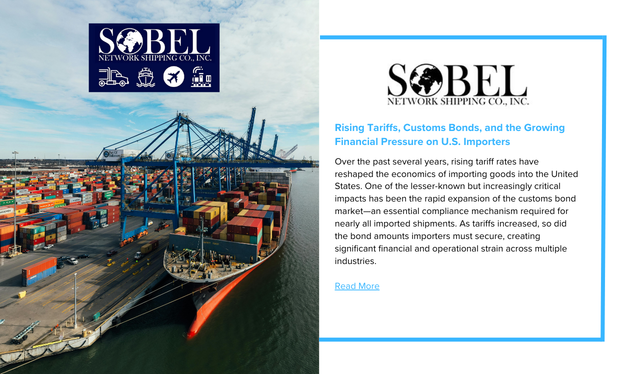
Over the past several years, rising tariff rates have reshaped the economics of importing goods into the United States. One of the lesser-known but increasingly critical impacts has been the rapid expansion of the customs bond market—an essential compliance mechanism required for nearly all imported shipments. As tariffs increased, so did the bond amounts importers must secure, creating significant financial and operational strain across multiple industries.
Customs bonds are required by U.S. Customs and Border Protection to guarantee the payment of duties, taxes, and fees on imported goods. These bonds protect the government in cases where an importer fails to meet its financial obligations. Typically issued by specialized surety insurance providers, customs bonds are calculated based on a percentage of an importer’s duties and taxes over a rolling 12-month period. When tariff rates rise, required bond limits rise alongside them.
Why Customs Bond Costs Have Surged
As tariff rates increased sharply on many categories of imported goods, the total duties owed by importers grew accordingly. Because customs bonds are generally set at 10% of an importer’s annual duties and taxes, higher tariffs have translated directly into higher bond requirements. In many cases, importers have seen bond limits increase by several hundred percent, pushing requirements far beyond the regulatory minimum and into the hundreds of millions of dollars for large-volume shippers.
Bond premiums—often calculated as roughly 1% of the bond value—have increased in parallel. For importers, this means higher upfront costs simply to maintain compliance and keep goods moving through ports.
The Rise of Bond Insufficiency Notices
Another consequence of volatile tariff conditions has been a sharp increase in bond insufficiency notices. These notices are issued when Customs determines that an importer’s existing bond no longer provides adequate coverage for current duty exposure. When this occurs, importers must quickly increase their bond amount or risk having shipments delayed or stopped at the port.
Bond insufficiencies have grown rapidly in recent years, driven by fluctuating tariff rates and rising import values. Smaller importers are especially vulnerable, with many insufficiency notices affecting bonds under relatively modest limits. Without timely action, companies can face costly delays, storage fees, detention charges, and disrupted supply chains.
Collateral Requirements Add Another Layer of Pressure
As bond limits grow, many surety providers now require importers to post collateral in addition to paying bond premiums. This collateral serves as additional security to guarantee tariff payments and is typically held for more than 300 days while Customs finalizes duty assessments.
For importers, collateral requirements can significantly impact cash flow and liquidity. Funds tied up in bond collateral are unavailable for inventory purchases, operations, or growth initiatives—placing further strain on businesses already navigating higher landed costs.
Market Impact and Operational Complexity
While the insurance market has largely been able to meet increased demand for customs bonds, the process has become more complex and time-sensitive. Surety providers are applying stricter underwriting standards, enhanced credit reviews, and more conservative risk modeling to account for unpredictable tariff exposure.
Industries importing capital goods, consumer products, luxury items, and everyday necessities have all been affected. Companies with strong balance sheets are generally better positioned to secure higher bond limits, while those with tighter finances may face higher premiums, collateral requirements, or delays in bond approval.
Uncertainty Around Tariff Refunds and Timing
The broader trade environment has also introduced uncertainty around the potential reversal or adjustment of tariffs. If tariffs are reduced or deemed invalid through legal or regulatory changes, importers may become eligible for duty refunds. However, recovering funds tied up in customs bonds and collateral is rarely immediate.
Any reduction in bond requirements typically requires formal petitions, audits, and verification by surety providers. Even under normal circumstances, the process to release collateral can take 30 to 60 days or longer, particularly when large sums or high volumes of transactions are involved.
Planning Ahead in a Volatile Trade Environment
For importers, proactive bond management has become essential. Best practices include:
-
Regularly reviewing bond utilization levels
-
Requesting advance alerts when bonds approach capacity
-
Coordinating closely with customs brokers and surety providers
-
Planning for lead times when increasing bond limits
-
Factoring potential collateral requirements into cash-flow forecasts
With tariff rates and trade policies continuing to evolve, customs bond management is no longer a back-office formality—it is a critical component of supply chain strategy and financial planning.
As uncertainty remains a defining feature of global trade, importers that stay informed, responsive, and financially prepared will be best positioned to avoid disruptions and maintain operational continuity.